

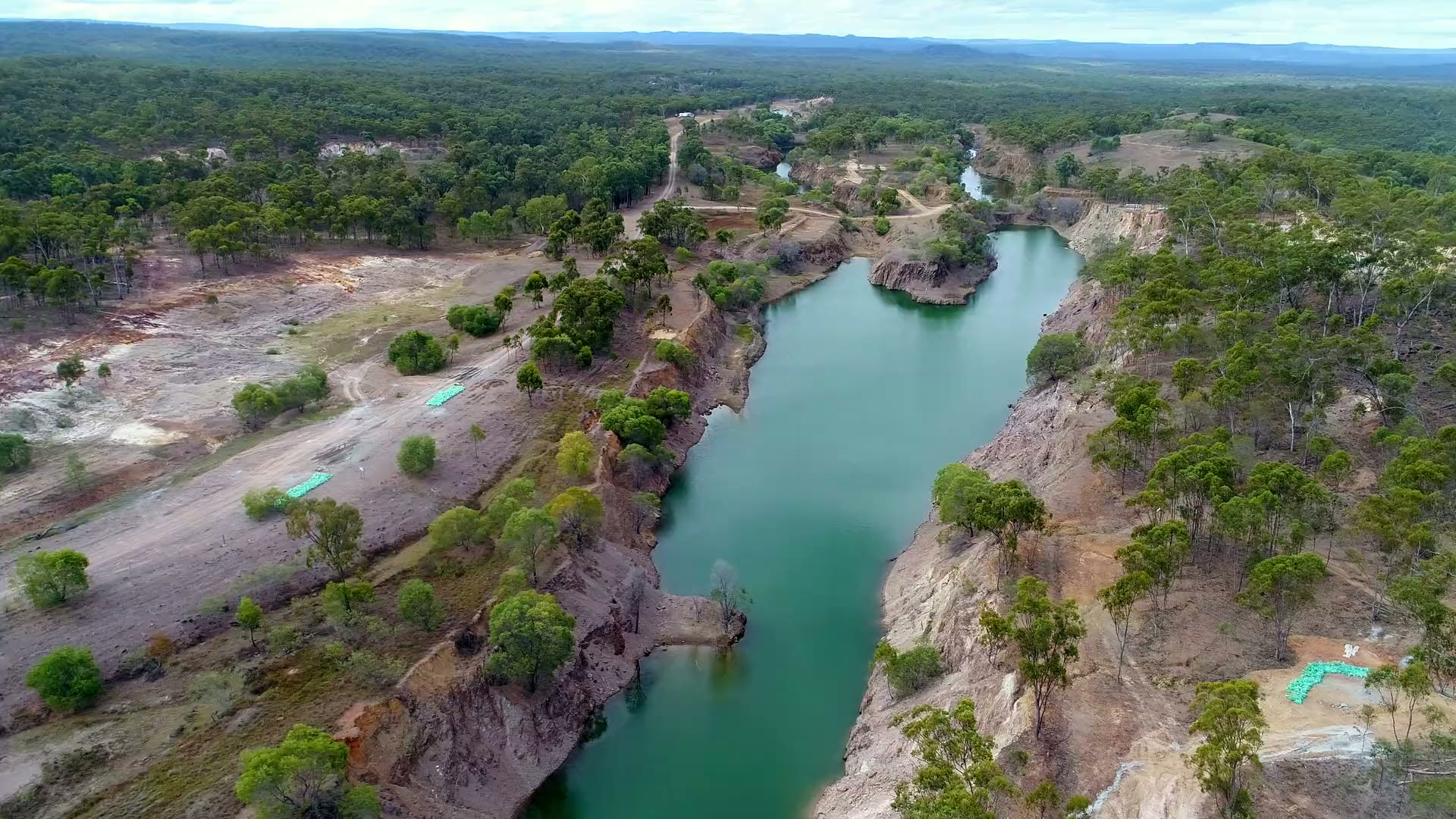
Camel Creek
Amanda Bel Gold & Antimony Fields, about 70km west of Ingham
Key facts
| Location | Amanda Bel Gold & Antimony Fields, North Queensland |
|---|---|
| Status | Production Ready |
| Commodities | Gold and antimony |
| JORC resource | 202,000 oz Au in 2.41Mt @ 2.6 g/t Au (60% Indicated) |
| Resource estimate | Widenbar & Associates, 2022. Gold only |
| Antimony | Not yet in a JORC resource. A first gold & antimony estimate is in preparation |
| Ownership | Golden Ant Mining Pty Ltd: Great Eastern Gold 64.5%, Australian Winch and Haulage 35.5% |
| Tenure | Seven granted Mining Leases, prescribed for antimony, gold and silver |
| Processing route | Split flotation. Site of the central processing hub |
| Plan | Production targeted for early 2027 |
| Study | Development Study, October 2026 (scoping level); pre-feasibility to follow the new resource |
Overview
Camel Creek is Great Eastern Gold’s flagship gold & antimony project and the site of the central processing hub. It is an existing mine site on granted Mining Leases, with a JORC gold resource of 202,000 oz (2.41Mt at 2.6 g/t Au, 60% Indicated).
Between 1989 and 1995 the previous operators mined only the oxide gold cap, to about 30–35m, and heap-leached it. Stibnite in fresh rock cannot be heap-leached, so the primary gold & antimony ore beneath the pits was left in place and has never been mined. The Camel Creek corridor runs for more than 5km and has 28 historic pits.
The centrepiece is the Hinge Zone at Pit 8/10, where the gold & antimony lode thickens in a fold hinge. Great Northern Minerals’ 2020–21 drilling discovered it, and four of Great Eastern Gold’s 2026 holes there have intersected high-grade antimony.
Great Eastern Gold is targeting production at Camel Creek in early 2027. The October 2026 Development Study plans a build-up to a split-flotation plant of about 1Mtpa, fed by three pit areas along the corridor.
Highlights
- The primary antimony-gold ore has never been mined: the 1989–95 operation took only the oxide gold cap
- Wide lodes: typically 2–5m, thickening to about 20m in fold hinges, which suits bulk mechanised mining
- A clean, high-grade concentrate in test work: 62.1% Sb at 1.0% arsenic
- A database of about 4,500 historical drill holes, with more than 100 new holes drilled in 2026
- An existing mine site: granted Mining Leases, an Environmental Authority, historic pits and haul roads, and road access to the Port of Townsville
- Antimony is on the critical minerals lists of Australia and the United States
Geology
Camel Creek is a turbidite-hosted stibnite–arsenopyrite–gold vein system, the same style as Hillgrove and Costerfield. Its high-grade antimony sits in predictable structural positions: lenses line up along north-west corridors where they cross the north-east mineralised shears, and they thicken in fold hinges.
The 2026 holes were designed from that structural model and intersected the target zones where predicted. At Black Bull, on the same corridor, a 2026 hole intersected a 15m (true width) zone directly beneath a historical hole that cut only 2m of the same lode.
Every 2026 hole has hit its target within a few metres of the predicted depth.
Hinge Zone drilling, 2020–21
| Hole | From | True width | Antimony | Gold | Including |
|---|---|---|---|---|---|
| CCRC50 | 189m | 5.5m | 2.10% Sb | 14.1 g/t Au | 3m @ 11.2% Sb and 67.7 g/t Au from 191m |
| CCRC54 | 160m | 8.6m | 1.07% Sb | 9.9 g/t Au | 3m @ 3.83% Sb from 165m; 5m @ 20.2 g/t Au from 164m |
| CCRC15 | 109m | 4.8m | 2.80% Sb | 4.1 g/t Au | 2m @ 12.9% Sb from 115m; 1m @ 15.0 g/t Au from 116m |
| CCRC86 | 125m | 2.3m | 0.93% Sb | 24.7 g/t Au | 1m @ 2.11% Sb from 125m; 1m @ 87.6 g/t Au from 127m |
Laboratory assays (Intertek) on 1m RC chip and half-core samples, gold by fire assay, from Great Northern Minerals’ 2020–21 drilling. The four intercepts average 5.3m true width at 1.71% Sb and 11.3 g/t Au.
Metallurgy
Camel Creek ore is treated by split flotation, which gives two saleable concentrates: a high-grade antimony-gold concentrate and a gold-arsenic concentrate. Petrography explains the clean result: massive stibnite ore is very poor in pyrite and arsenopyrite, and the grains are coarse enough to liberate at a normal grind.
| Test | Product | Result |
|---|---|---|
| Amdel 07340, hole GA336 (primary ore) | Bulk rougher concentrate | 89.2% gold and 92.7% antimony recovery |
| Amdel 07070/10, hole GC36 | Bulk rougher concentrate | 91.6% gold recovery |
| Amdel 06870/5, hole GA194 | Bulk rougher concentrate | 89.6% gold recovery |
| ALS 2021, CC-RC-01 | Bulk rougher concentrate | 90.5% gold recovery |
| Amdel 07340 Test 3, hole GA343 (high antimony) | Split float, sighter test | 62.1% Sb concentrate at 1.0% arsenic; 45 g/t Au gold-arsenic concentrate |
Core Metallurgy reviewed the full test-work record for Great Eastern Gold in July 2026. Final test work on fresh diamond core will set the design recoveries.
How Camel Creek compares
Hillgrove and Costerfield are Australia’s only producing antimony mines, and both draw on deposits that have been mined for years.
| Feature | Camel Creek (Qld) | Hillgrove (NSW) | Costerfield (Vic) |
|---|---|---|---|
| Geology | Turbidite-hosted stibnite–arsenopyrite–gold quartz veins | Turbidite-hosted stibnite–gold quartz veins | Turbidite-hosted stibnite–gold quartz veins |
| Typical lode width | About 5m, up to 20m | 0.5–3m | Generally under 1m |
| Antimony concentrate grade | 62% Sb (test work) | About 52.5% Sb | 40–45% Sb benchmark |
| Mining history | Oxide gold cap only (1989–95); primary antimony-gold ore never mined | Mined for more than a century; restarted September 2026 | Mined continuously since 2006 |
From Great Eastern Gold’s October 2026 Development Study, which draws on the Larvotto Resources Hillgrove DFS (May 2025), Mining Weekly (September 2026) and Alkane’s Costerfield reserves.
Tenure and approvals
Seven granted Mining Leases (ML 4522, 4523, 4524, 4525, 4534, 4540 and 6952) cover Camel Creek. Golden Ant Mining holds the Environmental Authority, which will be amended to cover the flotation plant, tailings facility and underground mines. Black Bull lies on the same corridor; the company plans to re-establish a Mining Lease there, joining it to the Camel Creek operating area.
Queensland’s August 2026 legislation allows critical-minerals projects to be declared State Strategic Projects, with coordinated approvals. Great Eastern Gold intends to apply.
Photos, maps and sections
Select an image to enlarge it.